> For the complete documentation index, see [llms.txt](https://docs.sprinthub.com/llms.txt). Markdown versions of documentation pages are available by appending `.md` to page URLs; this page is available as [Markdown](https://docs.sprinthub.com/en/common-questions/automation-template/emails-template.md).
# Emails - Template
Email templates are pre-defined message models that can be easily customized and used for different purposes
In the general menu, click on '**Link**' and then on '**Emails**';
Click on '**New**';
After filling in your email information, click on '**Choose Template**';
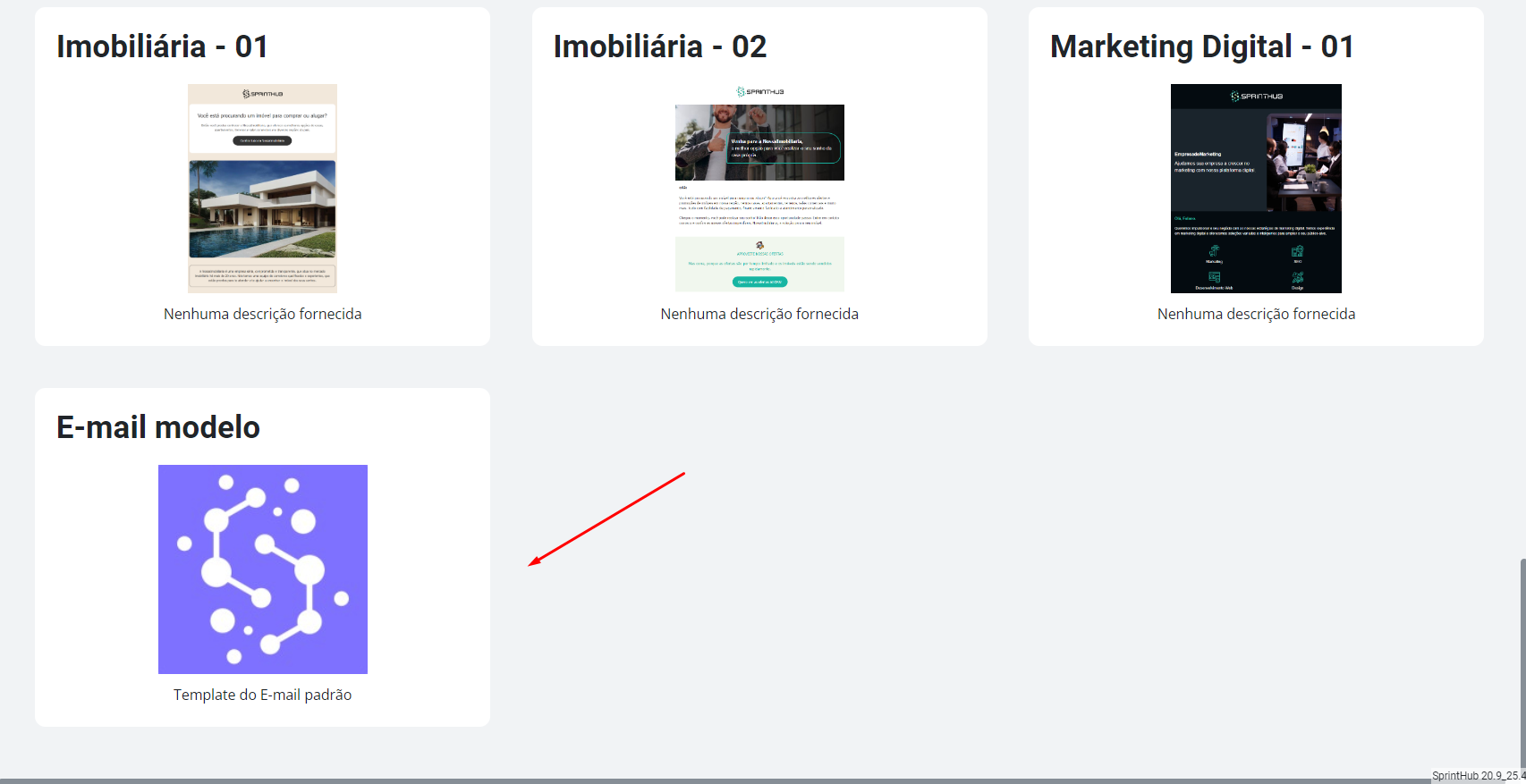
Right after, choose which Template model you want to use. If you prefer, choose models that are more similar to your email segment. *For example*: Promotion.
When selecting your Template model, you can **edit it** however you prefer, being able to change **Email name**, **images**, **texts**, add **Links to your social media** among others.
Once that's done, click on **Save**, to save your email template.
## To create an Email Template, follow these steps:
* Click on the name of the email you want to create the Template for;
* Next to the "Back" button, click the three dots and choose "Create Template";
* Setting up your template to save;
**Name:** Enter the identification for your template;\
**Image**: Insert an image to identify your template;
**Description:** Describe in detail what the template refers to;
**Public Template:** If enabled, all system users will be able to view and edit the template;
**Share with:** All selected users will be able to view and use the template;
After making the changes, click on **“Save Template”**.
*Your Template has been saved and created successfully!*
**See similar articles:**
{% content-ref url="/pages/b6b29d0e4e7844f335a164d37cf7438b537bed87" %}
[Email](/en/topics/relate/email.md)
{% endcontent-ref %}
---
# Agent Instructions
This documentation is published with GitBook. GitBook is the documentation platform designed so that both humans and AI agents can read, navigate, and reason over technical content effectively. Learn more at gitbook.com.
## Querying This Documentation
If you need additional information that is not directly available in this page, you can query the documentation dynamically by asking a question.
Perform an HTTP GET request on the current page URL with the `ask` query parameter, and the optional `goal` query parameter:
```
GET https://docs.sprinthub.com/en/common-questions/automation-template/emails-template.md?ask=&goal=
```
`ask` is the immediate question: it should be specific, self-contained, and written in natural language.
`goal` is optional and describes the broader end goal you are ultimately trying to accomplish on behalf of the user. GitBook uses it to tailor the answer towards what is most useful for that goal.
The response will contain a direct answer to the question and relevant excerpts and sources from the documentation.
Use this mechanism when the answer is not explicitly present in the current page, you need clarification or additional context, or you want to retrieve related documentation sections.