> For the complete documentation index, see [llms.txt](https://docs.sprinthub.com/llms.txt). Markdown versions of documentation pages are available by appending `.md` to page URLs; this page is available as [Markdown](https://docs.sprinthub.com/topicos/relacionar/fluxos-de-automacao/duvidas-comuns/fluxo-de-automacao-enviando-arquivos-rastreados.md). Agents can also search and read this documentation through its [MCP server](https://docs.sprinthub.com/~gitbook/mcp).
# Fluxo de Automação - Enviando Arquivos Rastreados
Fluxo de Automação - Enviando Arquivos Rastreados
Você pode enviar arquivos rastreados em uma mensagem via Fluxo de Automação, e assim acompanhar quem está acessando seus conteúdos e como eles estão interagindo com eles, por meio dos Arquivos Rastreados.
* [**Para aprender sobre Arquivos Rastreados clique aqui**](https://docs.sprinthub.com/topicos/converter/arquivos-rastreados/arquivos-rastreados-como-criar-e-editar)
Agora vamos configurar um Fluxo de Automação.
1- Clique em Fluxo de Automação, clique em +Novo
2- Digite o Nome, adicione o Segmento em que será acionado, e deixe Publicado para ativar, clique em "Abrir Construtor"
* [**Aprenda a criar segmentos aqui**](https://docs.sprinthub.com/topicos/relacionar/segmentos)
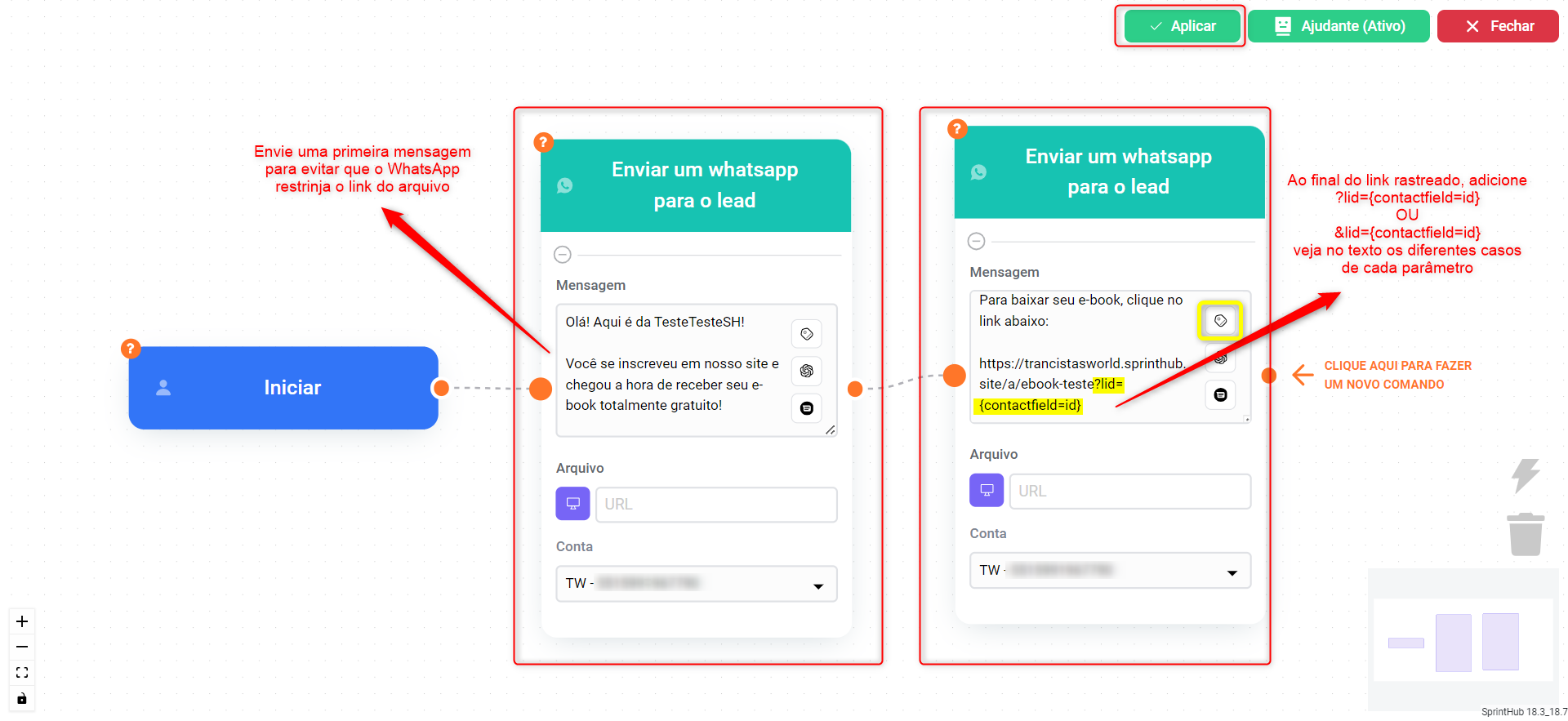
3 - No construtor, adicione o primeiro bloco de mensagem. Nele, envie uma mensagem de saudação inicialmente, SEM o arquivo rastreado.
\
**OBS:** adotamos esta estratégia pois o WhatsApp pode tornar seu link não clicável na primeira mensagem enviada, isso acontece por uma medida de segurança do próprio WhatsApp. Para saber mais, clique aqui.
No segundo bloco de mensagem adicione o link do arquivo rastreado JUNTO A MENSAGEM que será enviada seguido de:
* ?lid={contactfield=id} ➡️ no caso do link NÃO terminar com o ponto de ?
OU
* \&lid={contactfield=id} ➡️ no caso do link terminar com o ponto de ?
**OBS:** {contactfield=id} será adicionado através do botão de token, escolha o token Lead (ID)\
\
Clique em Aplicar, Salve o Fluxo.
Dessa forma, os leads que clicarem neste arquivo e já foram identificados na SprintHub (seja por já terem preenchido algum formulário, por exemplo), aparecerão na lista dos Arquivos Rastreados, conforme print abaixo:
---
# Agent Instructions
This documentation is published with GitBook. GitBook is the documentation platform designed so that both humans and AI agents can read, navigate, and reason over technical content effectively. Learn more at gitbook.com.
## Querying This Documentation
If you need additional information that is not directly available in this page, you can query the documentation by asking a question.
Perform an HTTP GET request on the following URL with the `ask` and `goal` query parameters:
```
GET https://docs.sprinthub.com/topicos/relacionar/fluxos-de-automacao/duvidas-comuns/fluxo-de-automacao-enviando-arquivos-rastreados.md?ask=&goal=
```
`ask` is the immediate question: it should be specific, self-contained, and written in natural language.
`goal` is what the user is ultimately trying to achieve, the reason they need the answer. Sharing it helps GitBook give you a better, more relevant answer. A goal is most helpful when it describes the outcome the user wants rather than restating the question. For example, with `ask=how do I create an API token`, a goal like `automate deployments from our CI pipeline` lets GitBook tailor the answer to that use case.
The response will contain a direct answer to the question and relevant excerpts and sources from the documentation.
Use this mechanism when the answer is not explicitly present in the current page, you need clarification or additional context, or you want to retrieve related documentation sections.